Santiago Island
Santiago, the largest island in Cape Verde, brings together the capital Praia, the UNESCO site of Cidade Velha, lush valleys and black sand beaches. A microcosm of Cape Verdean history and landscapes.
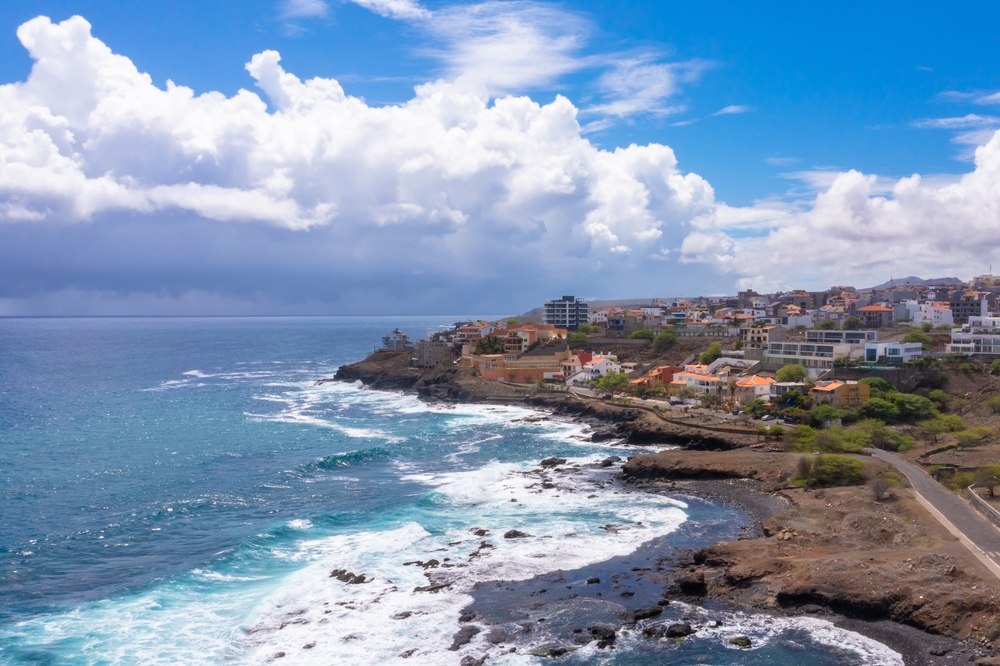
Santiago is the largest island in the Cape Verde archipelago and its political, historical and demographic heart. Praia, its capital, is home to more than a third of the nation's population. The island blends volcanic landscapes, lush valleys, black sand beaches and historical sites connected to the Atlantic slave trade. It was here that the Portuguese founded Cidade Velha, the first European settlement in a tropical zone, now listed as a UNESCO World Heritage site.
Quick reference
- Access: International flight to Praia's Nelson Mandela International Airport (RAI), served from Europe and Africa.
- Internal transport: Aluguer (shared taxis) between Praia and main towns; car rental available in Praia.
- Recommended duration: 3 to 5 days to combine Praia, Cidade Velha, inland valleys and beaches.
- Dress code: Light clothing; cover shoulders and knees when visiting churches.
- Language: Portuguese and Cape Verdean Creole (Kriolu di Santiago).
- Currency: Cape Verdean Escudo (CVE).
What to see
Santiago offers a rare diversity of landscapes for an island of modest size. The interior reveals ribeiras (steep valleys) covered with banana plants, sugar cane and mango trees. The Serra da Malagueta massif rises above 1,000 metres and shelters a protected cloud forest. The coasts alternate between volcanic black sand beaches in the north and calmer coves in the south.
History and context
Santiago was colonized by the Portuguese in 1462. Cidade Velha — formerly Ribeira Grande — became the first European urban centre in sub-Saharan Africa and a major hub of Atlantic trade, notably the slave trade. The city was plundered by Francis Drake in 1585, then by French corsairs. Its decline in favour of Praia in the 18th century preserved it from modern transformations. UNESCO inscribed it as a World Heritage site in 2009.
Highlights of your visit
Cidade Velha
The former capital preserves the Fortaleza Real de São Filipe, a 16th-century fortress overlooking the bay, the cathedral ruins and the Pelourinho, a pillory symbolizing slavery. The site can be visited on foot in a few hours from Praia.
Praia and the Plateau
Praia's historic centre sits on a tabular plateau surrounded by cliffs. The Sucupira market is Cape Verde's largest market: fabrics, spices, crafts and local produce mingle in perpetual animation. Praça Alexandre Albuquerque forms the civic heart of the Plateau.
Serra da Malagueta
This protected natural park shelters a high-altitude cloud forest, habitat of endemic birds. Hiking trails offer views of both sides of the island on clear days.
Tarrafal
In the island's north, Tarrafal is known for its crescent-shaped beach with calm waters and its colonial concentration camp, now a museum, where opponents of Salazar's regime were imprisoned.
Photography tips
Late afternoon light is ideal for photographing the Fortaleza Real de São Filipe and Cidade Velha's ruins. Sucupira market is most photogenic in the morning, before the heat sets in. In Serra da Malagueta, morning mist creates special atmospheres but may obscure panoramic views — favour mid-day in the dry season.
Location and access
Santiago is the central island of the Cape Verde archipelago, in the Atlantic Ocean, about 570 km west of Senegal. Praia, the capital, is the main hub for connections to other islands by domestic flights (TACV/Binter) and sea links. Cidade Velha is about fifteen kilometres west of Praia, accessible by aluguer or taxi.
Nearby
- Cidade Velha — UNESCO site, the first European colonial city in a tropical zone, a must-see.
- Tarrafal — protected beach and colonial camp museum in the island's north.
- Serra da Malagueta — highland natural park with cloud forest and hiking.
- Sucupira Market — Cape Verde's largest market, in the heart of Praia.
Frequently asked questions
The dry season, from November to June, offers the most pleasant conditions: clear skies, moderate temperatures. The rainy season (July–October) greens the island's interior but may complicate hiking.
Aluguer (shared taxis) depart from Praia to main towns. For greater flexibility, car rental is available in Praia. Cidade Velha is easily reached by individual taxi.
Yes. Praia is the main hub of the archipelago. Domestic flights serve Fogo, Maio, São Vicente and other islands. Maio, a neighbour, is accessible by ferry or plane in under an hour.
Citizens of many countries, including France, Belgium and Switzerland, must obtain a visa or entry authorization (EASE) before departure. Check conditions with the Cape Verdean embassy or consulate before your trip.
Tarrafal beach in the north is renowned for its calm, shallow waters. Beaches near Praia may have currents; check locally before swimming.
Allow half a day to visit Cidade Velha at your own pace: the site, the fortress and the waterfront. A full day allows for unhurried exploration and lunch on-site.