Tarrafal
Tarrafal
In the north of Santiago Island, Tarrafal brings together a beach fringed with coconut palms, a fishing village and the former political prison camp from the Salazar era, now a museum.
On the northern coast of Santiago, the largest island in Cape Verde, Tarrafal unites a beach lined with coconut palms, a fishing village and a significant memorial site. This northern tip of Santiago contrasts with the aridity of the rest of the island through its lush setting and unique historical significance.
Why visit Tarrafal
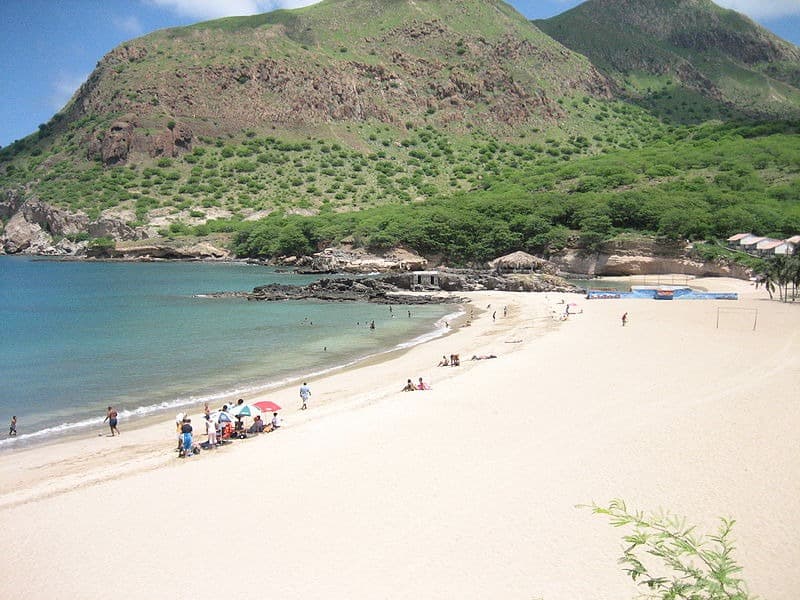
Tarrafal stands out for several reasons in Cape Verde. The main beach, roughly 1 km long, is divided by a rocky promontory and a jetty that form two clear sand coves. It is dominated by Monte Graciosa, a wooded mountain that frames the horizon to the south, and bordered by a coconut grove uncommon elsewhere in the archipelago.
Beyond the beach setting, the village is home to the former Tarrafal concentration camp, now a museum, which constitutes a central place of memory for understanding Cape Verde's colonial and political history in the 20th century.
Tarrafal camp: a site of remembrance
Until 1975, Tarrafal housed a detention camp for political opponents of Antonio de Oliveira Salazar's regime, Portugal's Prime Minister from 1932 to 1968. Detainees came from mainland Portugal as well as from Portuguese colonies in Africa (Angola, Guinea-Bissau, Mozambique, Cape Verde).
Chosen for its remoteness and harsh climate, the site operated through successive phases until Cape Verde's independence in 1975. Now converted into a museum, the former camp can be visited today: barracks, solitary confinement cells and original structures have been preserved. The visit sheds light on a lesser-known chapter of Luso-African history and usefully complements a beach stop at Tarrafal. Allow 1 to 1.5 hours on site.
What to see and do
The main beach
The beach stretches for approximately 1.02 km. The sand, clear and fine, contrasts with the darker volcanic sands common elsewhere in Cape Verde. Waters are calm on the northern bay side, more exposed on the southern side. Beach amenities are limited: bring a towel, umbrella and water. A few waterfront restaurants serve fresh fish and Cape Verdean dishes, and street vendors offer coconuts and fruit.
Water activities
Swimming is the main activity. Snorkelling is possible near the rocks of the central promontory. Depending on the season and available operators, boat trips may be offered from the nearby port for diving or marine wildlife observation; check locally, as availability varies.
Mar di Baxu
A short distance away, Mar di Baxu is a smaller, quieter beach, favoured by locals. It offers an alternative to the main beach if it gets crowded.
Monte Graciosa
The mountain overlooking Tarrafal is suitable for a hiking approach offering views of the bay and village. The trail is challenging in full heat; set out early and bring plenty of water.
When to go
Santiago's climate is tropical dry, with an average annual temperature of around 26°C around Tarrafal. The rainy season is concentrated from August to October, with peak precipitation in September, usually in brief showers. The most comfortable period for visiting runs from October to June, when skies are clear and heat is tempered by trade winds. For swimming, waters are warmest in late summer and early autumn.
How to get there
Tarrafal is located at the northern tip of Santiago, about 1.5 hours from Praia, the capital, situated in the south of the island. Several options are available:
- Aluguer (shared minibus): the most economical option, departures from Sucupira in Praia when the vehicle is full.
- Taxi or private transfer: comfortable, fare to be negotiated before departure.
- Car rental: the most flexible for exploring the island.
Two routes are possible: the central road via the highlands (faster, interior landscapes) or the coastal road via Calheta de São Miguel and Pedra Badejo (longer, ocean views).
Nearby and other Tarrafals in Cape Verde
Three beaches bear the name Tarrafal in the archipelago, which can cause confusion:
- Tarrafal de Santiago: the one described here, with lush bays and wooded setting.
- Tarrafal de Monte Trigo, on Santo Antão island: black volcanic sand, isolated fishing village. See also our guide Monte Trigo.
- Tarrafal de São Nicolau: known for its basalt organ formations along the coast.
If you extend your stay to other islands, the Cova crater and Topo de Coroa volcano, on Santo Antão, offer contrasting landscapes. On São Vicente, the Laginha beach, right in Mindelo, completes a coastal itinerary.
Frequently asked questions
Frequently asked questions
Plan your trip
Tarrafal fits into a Santiago circuit or a multi-island itinerary. To plan a journey combining Santiago, Santo Antão and São Vicente, consult our Cape Verde trips.
Interested in this visit?
We can include it in your personalised itinerary.