Santiago
Santiago, Cap-Vert's historic island, blends Cidade Velha, the first European tropical trading post, with badiu villages nestled in the mountainous interior and the bustling Assomada markets.
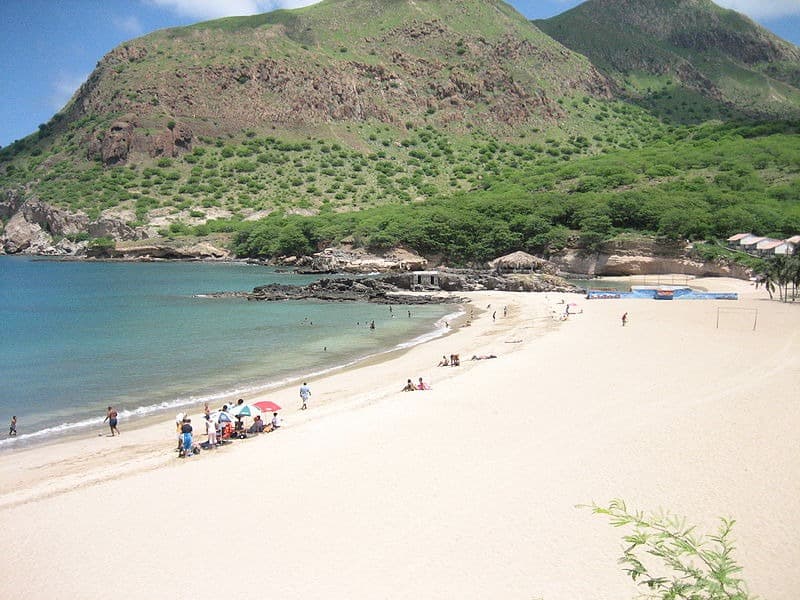
Santiago is the largest island in the archipelago and home to nearly half of Cap-Vert's population. Praia, the country's capital, sits on a coastal plateau to the south, the Platô, around which the districts of Achada Santo António, Prainha and Palmarejo have developed. Our English-speaking team based in Praia guides travelers across an island that unfolds in two distinct chapters: the dry, windswept coast, fringed with black sand beaches like Tarrafal to the north or São Francisco to the east, and the mountainous interior where greener, more agricultural—almost continental—landscapes emerge.
History weighs heavily on Santiago. Cidade Velha, fifteen kilometers from Praia, was founded in 1462 as Ribeira Grande. The first European settlement under the tropics, it served as a hub for the Atlantic slave trade for nearly two centuries. The pillory in the central square, the Real de São Filipe fortress built in 1587 to repel corsairs—including Francis Drake, who raided the city in 1585—and the cathedral ruins all bear witness to this era. UNESCO inscribed the site in 2009. It is also at Cidade Velha that badiu culture emerges, a blend of West African and Portuguese roots, of which batuque, the feminine percussion and song played on a rolled fabric cushion, remains the most vibrant expression.
The island's interior presents a striking contrast. Serra Malagueta, to the north, rises to 1,064 meters and forms a natural park where dragon trees, eucalyptus and endemic plants flourish. Temperatures here drop 5 to 8 degrees compared to the coast, and trails cross agricultural valleys still terraced for cultivation: sugar cane for grogue, the local spirit, cassava, corn, beans. Further west, Pico d'Antónia reaches 1,394 meters, the island's highest point. Villages like Rui Vaz, João Teves and Picos cling to these slopes and preserve a badiu rural way of life, marked by transhumance and collective field work.
Assomada, Santiago's second city, lives to the rhythm of its Wednesday and Saturday market, one of the most vibrant in the country. Here you'll find produce from the Picos valley, goat cheese from the interior, dried fish from Tarrafal and artisanal grogue from nearby trapiche distilleries. About ten kilometers away, the poilão de Boa Entrada, a giant fig tree some thirty meters high, is considered the island's oldest tree. Tarrafal, to the north, preserves on its bay a former Salazarist concentration camp, the Campo da Morte Lenta, where Portuguese opponents and later African nationalists were interned between 1936 and 1974. The site is open to visitors and provides valuable context for understanding the colonial history begun at Cidade Velha.
Santiago's climate is dry and warm year-round, with temperatures ranging from 22°C in February to 28°C in September on the coast. The rainy season, called locally the chuvas, concentrates between August and October, with brief but sometimes intense showers that green the interior for a few weeks. The rest of the year, the landscape is dry, ochre, swept by trade winds. At table, cachupa stands out—a stew of crushed corn, beans and meat or fish, the national dish that takes on its most generous form here on Santiago—and buzio guisado, sea snails stewed and shared as an aperitif on Praia's waterfront.
For our local agency, Santiago is the island where you understand what Cap-Vert is beyond the beach postcard. It rewards you through walking, conversation and food, more than through beaches.
Must-see
Cidade Velha and the Real de São Filipe fortress. A stroll through the first European tropical trading post, from the pillory to Rua Banana lined with low houses, then a climb to the 1587 fortress overlooking the mouth of Ribeira Grande.
Hiking in Serra Malagueta. Trails between 800 and 1,064 meters through humid vegetation of dragon trees and terraced crops, with possible descent to the village of Hortelão.
Assomada market on Wednesdays. Stalls of goat cheese, artisanal grogue and produce from the Picos valley, in a city that remains the agricultural heart of the island.
Batuque evening in a badiu village. Circle of women striking the fabric cushion, songs in Creole and torno dances, a direct heritage from 16th-century sugar cane plantations.
Tarrafal, bay and camp memory. Clear sand beach backed by Monte Graciosa, and a visit to the Salazarist concentration camp active from 1936 to 1974, now a museum.
When to go
Santiago is worth visiting year-round. The most comfortable period runs from November to June: temperatures of 22 to 26°C on the coast, dry skies, moderate trade winds. February and March are the coolest months, perfect for hiking in Serra Malagueta where temperatures drop to 16-18°C at night. From July to mid-October, the air becomes heavier, with peaks of 30°C in Praia and notable humidity.
The rainy season, brief and irregular, concentrates between mid-August and late October. Showers are short but can make some interior tracks difficult, particularly toward Rui Vaz and Pico d'Antónia. It is also when the island is at its greenest, appealing to those seeking agricultural landscapes rather than beaches. We avoid scheduling long hikes in September, statistically the rainiest month.
Practical tips
Plan at least three full days for Santiago: one day in Praia and Cidade Velha, one day in the interior with Assomada and Serra Malagueta, one day to reach Tarrafal via the eastern coast or the interior road. Five days allow you to add a night in Rui Vaz at altitude and a slower exploration of badiu villages. Nelson Mandela International Airport in Praia is the logical entry point, served by direct flights from Lisbon, Paris and Dakar.
Santiago combines easily with Fogo, a 45-minute flight away, for those wishing to extend to the volcano and vineyards of Chã das Caldeiras, or with São Vicente and Santo Antão for a striking contrast between historic island and hiking islands. Hotel comfort ranges from 4-star in Praia to simple guesthouses in the interior. This is an island that will speak most to travelers curious about history, music and encounters, less to those seeking solely beaches: for that, Sal and Boa Vista remain better equipped.